
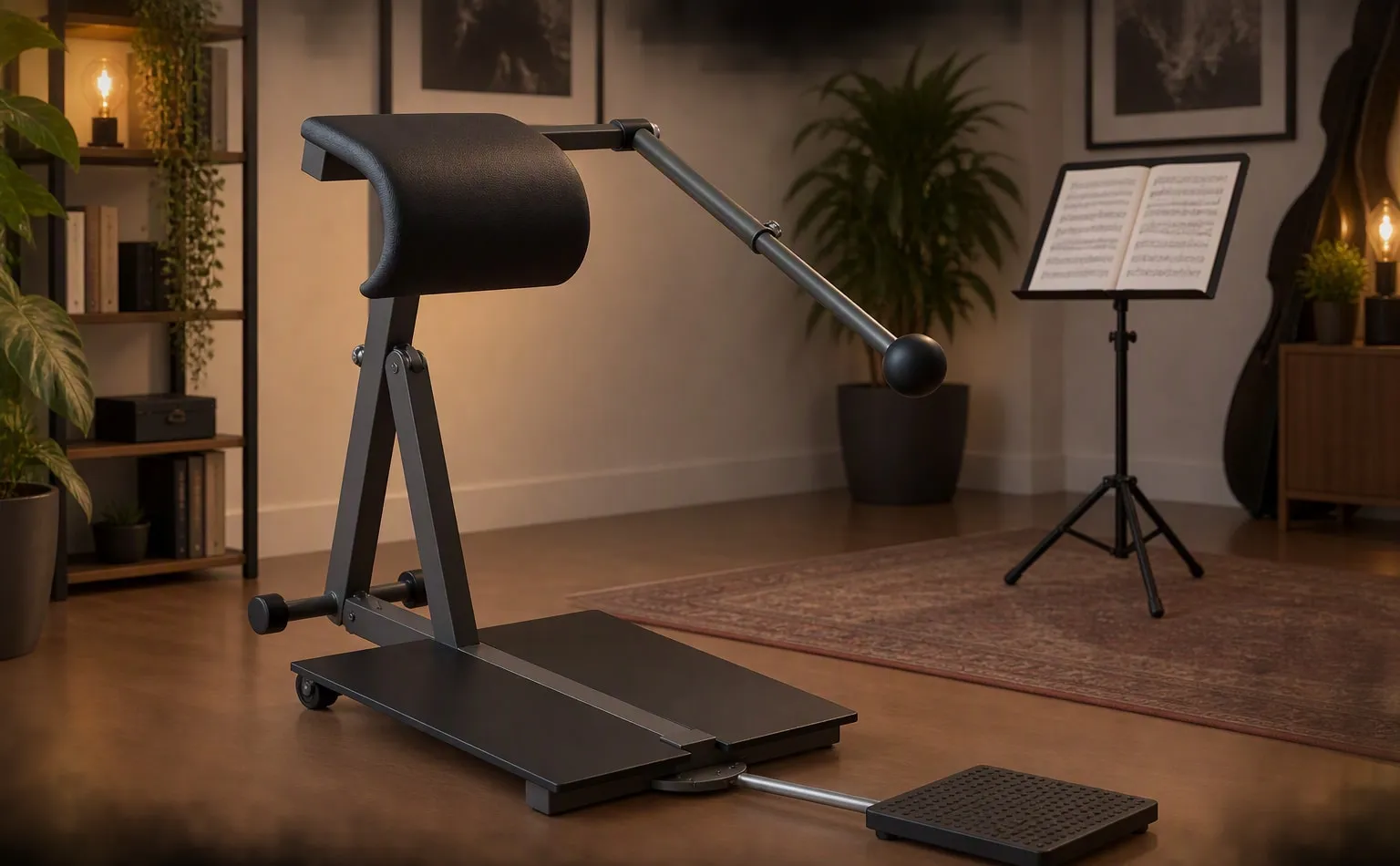
One biomechanical system
Most existing solutions attempt to solve isolated symptoms. Some improve comfort. Others improve portability. Others improve stability. Yet each addresses only a fragment of the problem.
Trinity was developed from a different premise: the body, the instrument and the support system cannot be treated as separate elements. They function as a single biomechanical system. If one element is inefficient, the entire system compensates.
Rather than adding accessories to an existing setup or forcing the musician into a predefined posture, Trinity unifies what has traditionally been treated as separate challenges: posture, stability, instrument control, ergonomics, resonance and transportability.
The goal is not to change how music is played. The goal is to remove the unnecessary obstacles standing between the musician and the music.
From compensation to organisation
Traditional playing systems rely heavily on the musician’s body to perform tasks that are not inherently musical. The body must stabilise the instrument, prevent slipping, control rotation, support part of the instrument’s weight, maintain posture and compensate for asymmetries. Physical and cognitive resources are consumed before musical expression even begins.
Trinity was conceived around a simple principle:
Whenever a mechanical problem can be solved mechanically, it should not be solved biologically.
The system redistributes responsibilities between the musician and the structure. Instead of asking the body to generate stability through compensation, Trinity provides stability through organisation, and the musician is free to devote more attention to technique, sound and artistic expression.
The four pillars of the system
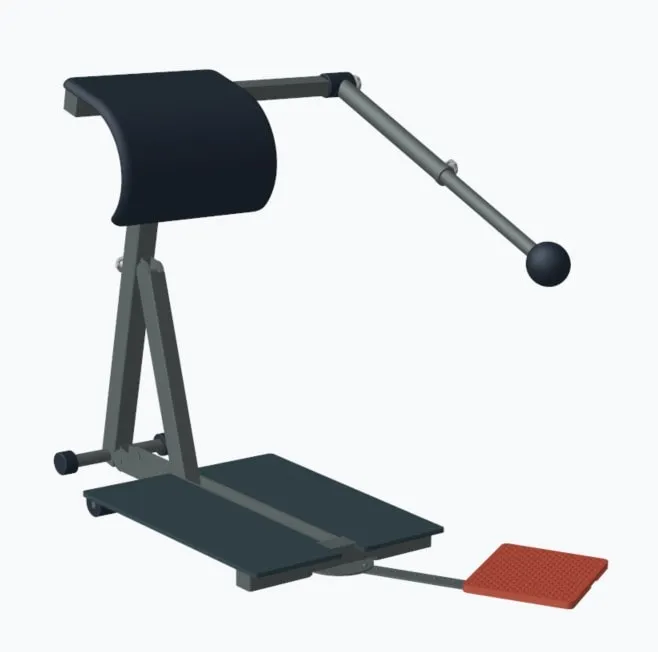
1. The stabilising platform: stability through body weight
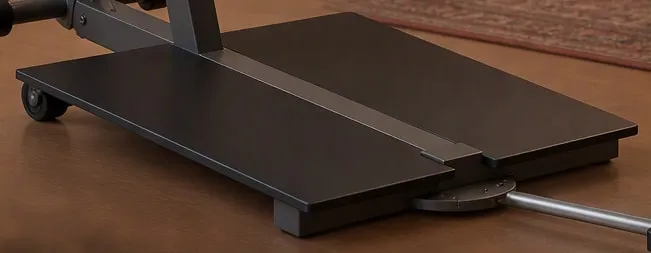
At the foundation of Trinity is a stabilising platform for the musician’s feet. Unlike conventional chairs, which rely on structural mass and rigid legs, Trinity uses the musician’s own body weight as part of the stabilising mechanism: as weight is transferred through the feet into the platform, the entire system becomes more stable.
Because stability no longer requires continuous muscular effort, the musician can keep adapting body position to the musical task while remaining within the same stable system. Standing, leaning and seated playing are not separate configurations: they remain simultaneously accessible throughout the performance.
Instead of forcing the player to adapt to the chair, Trinity allows the support system to adapt to the musician.
2. The ergonomic saddle: support without immobilisation
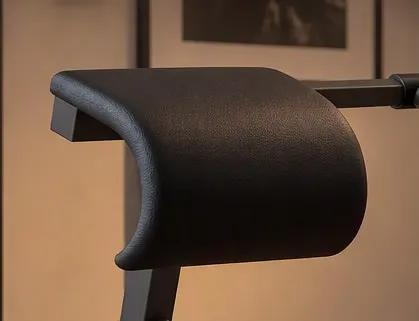
Traditional chairs are designed primarily for sitting. Double bass playing is not. It constantly requires subtle transitions between sitting, leaning, balancing, reaching and repositioning, and a conventional seat tends to lock the musician into a fixed posture.
Trinity replaces the seat with an ergonomic saddle that supports a dynamic relationship between body and instrument. The musician can move fluidly between sitting and leaning without losing support. The objective is not to impose a “perfect posture”, but to let posture evolve naturally with the music.
3. The instrument support arm: sharing the weight
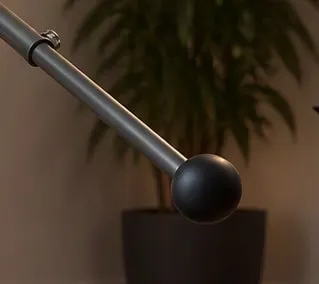
One of the most overlooked demands of double bass playing is the continuous responsibility of supporting and orienting the instrument. In traditional setups, much of this work falls on the body, often through the pelvis, knees and left leg.
The support arm is the most distinctive and original component of the system. It transfers part of that responsibility to the structure, sharing a portion of the instrument’s weight while keeping the essential physical relationship between player and bass. The result is reduced physical loading, improved stability, less compensatory tension, greater freedom of movement and more consistent instrument orientation.
The support arm also allows the player to adjust and maintain the desired playing angle of the instrument. Rather than continuously correcting the bass position through muscular effort, players can define the orientation that best suits their anatomy, technique and artistic preferences, while the system helps preserve that position throughout the performance.
The benefits may extend to the instrument itself. The left leg often presses against the body of the bass to stabilise it, which can partially dampen its vibration. By moving part of that support function to a mechanical structure, Trinity lets the instrument resonate more freely.
The goal is neither to isolate the bass from the player nor to fix it rigidly in place. The bass remains connected to the player, but no longer depends entirely on the player’s body for its stability.
4. The integrated anti-slip system: stability without dependency

Most double bass players depend on external endpin stoppers or floor accessories. They wear out, vary in reliability and often introduce uncertainty into performance.
Trinity integrates anti-slip functionality directly into the system, so the endpin stays securely positioned without additional accessories. The result is more predictable instrument behaviour, greater confidence on stage and less cognitive effort spent preventing unwanted movement. Stability becomes a property of the system rather than an external concern.
What makes Trinity different
Most existing solutions optimise a single variable. A comfortable chair improves comfort. A foldable solution improves transport. An endpin stopper improves stability. A footrest changes the instrument’s position. Musicians are forced to choose between competing priorities: stability or freedom, transportability or support, instrument control or ergonomic comfort.
Trinity was designed to eliminate those compromises. It brings together, in a single integrated system, what is traditionally fragmented across multiple products:
Not as independent accessories, but as parts of a unified ergonomic system.
How it works: stabilise the musician first
The central innovation of Trinity is simple. It does not begin by stabilising the instrument. It begins by stabilising the musician.
Traditional setups focus on supporting the instrument and leave posture, balance, orientation and control to the player, whose body ends up solving several mechanical problems at once. Trinity reverses this logic: rather than asking the body to create stability, it creates stability around the body. When the musician is organised and supported, control of the instrument becomes easier, more natural and more efficient.
A different model of stability
Traditional chairs provide a place to sit. They do not organise the relationship between the musician and the instrument. For an instrument as large and asymmetrical as the double bass, there is no single fixed posture that offers optimal balance, freedom of movement and access to every register.
Instead of searching for one “correct” position, Trinity supports multiple stable positions simultaneously. The musician can move between sitting, leaning and standing support while keeping control of body and instrument.
Movement is no longer the enemy of stability. Movement becomes part of the stability itself.
The stabilisation principle
- The musician is stabilised first The adjustable foot platform forms the foundation. By transferring body weight through the feet into the structure, Trinity creates a stable base without continuous muscular effort. Instead of fighting gravity, the system works with it.
- The instrument is supported without being fixed The support arm shares part of the instrument's weight, and the anti-slip interface prevents unwanted endpin movement. The double bass is neither fully fixed nor fully carried: it stays connected to the musician, free to resonate, while unwanted instability is greatly reduced.
- Stability without rigidity Many solutions achieve stability by restricting movement. Trinity does not hold the musician in place or lock the instrument. Posture adjustments and position changes happen naturally, without compromising control.
Continuous adaptation
Double bass playing is inherently dynamic. Different passages require different body positions, different registers require different spatial relationships, and different technical challenges require different strategies of balance and support. That is why Trinity does not impose a single ideal posture: it allows continuous micro-adjustments throughout the performance.
The goal is not to eliminate movement. The goal is to eliminate unnecessary compensation.
The essence of the idea
Traditional approach
- Instrument instability
- Body compensation
- Physical load
- Mental load
- Fatigue
Trinity approach
- Musician stability
- Instrument stability
- Reduced compensation
- Greater availability
- Better music
Traditional systems ask the body to create stability. Trinity creates stability so the body can focus on music. It does not seek to constrain movement, but to organise it: to provide a stable foundation from which the musician can move freely, control the instrument reliably and devote more attention to what truly matters, making music.
Folds for transport
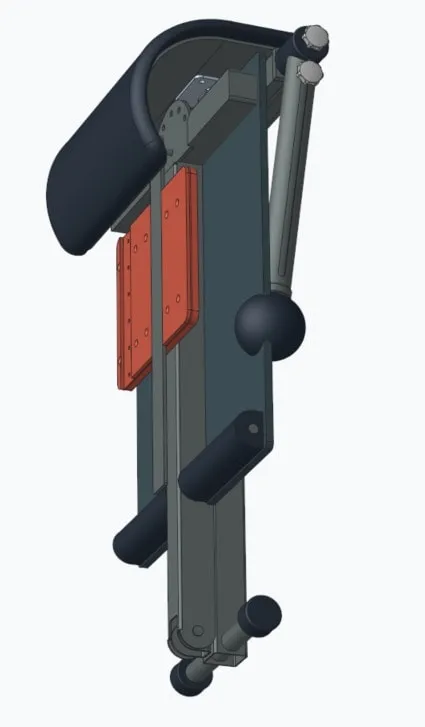
Trinity folds into a compact configuration, making transport and storage significantly more practical than many traditional performance setups.
Benefits for the musician
The benefits of Trinity are not limited to one area of performance. They emerge across the entire playing experience.
Posture
More organisation. Less compensation. With both feet supported and less need for asymmetrical stabilisation, the pelvis, spine and upper body keep a more organised relationship: an efficient starting point from which natural movement can occur.
Technique
Less effort. More control. The platform and support system recreate the freedom of standing while preserving the support of sitting, which may improve access to the strings, precision in demanding passages and consistency across registers.
Sound
Less interference. More resonance. The double bass was designed to vibrate freely. Moving part of the stabilisation from the legs to the system reduces interference between player and instrument.
Beyond the musician
For orchestras: greater consistency through rehearsals and performances, better endurance in long programmes, less disruption from fatigue and discomfort, more attention for collective listening and better musical communication within the section. Healthier musicians create more resilient ensembles.
For audiences: the audience is the final beneficiary. When musicians dedicate less attention to compensation and more to expression, audiences receive greater presence, precision, emotional communication and artistic impact. Every memorable performance begins long before the first note is heard: it begins with the conditions in which musicians are asked to create.
The vision
Trinity does not claim to replace technique. It does not replace practice. It does not replace artistry. Its purpose is simpler: to remove avoidable obstacles from the relationship between the musician and the double bass.
Excellence should demand dedication. It should not demand unnecessary suffering.
Beyond ergonomics
Trinity was not designed simply to reduce discomfort or improve posture.
At its deepest level, the system is based on a different idea: that every musician carries something unique within them. Every musical phrase begins long before it becomes sound. It begins as intention, imagination, emotion and meaning.
Before that inner world can reach the audience, it must travel through several layers: the mind, the body, the instrument, and finally the air itself.
- Intention
- Mind
- Body
- Instrument
- Air
- Audience
When any part of that chain is burdened by unnecessary tension, fatigue, instability or compensation, the message becomes less clear. The artistic intention remains the same, but its expression becomes more difficult.
For this reason, Trinity is not only concerned with supporting the instrument. Its purpose is to help create conditions in which physical effort interferes less with musical expression.
The goal is not to control the musician. The goal is not to control the instrument. The goal is to make the connection between them more transparent.
Because the most beautiful music does not originate in the hands alone. It begins much deeper and travels through the entire person before becoming sound.
The harmony of the body is reflected in the beauty of the music.
Trinity exists to help preserve that harmony. Let your true self shine: a clearer path from the heart to the world.